Friday, June 16, 2006


Wednesday, June 14, 2006
Brake free
Sundown on the highway
The asphalt vapour lingers on
While the symphony rises
An evening leisurely melts
It is a balmy drive.
The milestones sprint past
Ineluctably, the midnight is caught
Warped; it begins to rain.
Winds lashing against him
Half drenched, in trance awhile
Hair blowing into eyes
The taxi driver breaks into a tune.
The asphalt vapour lingers on
While the symphony rises
An evening leisurely melts
It is a balmy drive.
The milestones sprint past
Ineluctably, the midnight is caught
Warped; it begins to rain.
Winds lashing against him
Half drenched, in trance awhile
Hair blowing into eyes
The taxi driver breaks into a tune.
Tuesday, June 13, 2006

Tuesday, May 16, 2006
Friday, May 12, 2006
Sunday, April 30, 2006
Night Out
Blown in the storm
A paper airplane zips by
Just as the mist sets in
A crimson scarf flutters atop the lamp post
A vagrant strums the guitar
Burning bright, the city lights
A lone skinny dog ambles
Across the pavement, moths flood the neon glow
The warm gust is still a little far off
Upon snug taverns rests
A paper airplane zips by
Just as the mist sets in
A crimson scarf flutters atop the lamp post
A vagrant strums the guitar
Burning bright, the city lights
A lone skinny dog ambles
Across the pavement, moths flood the neon glow
The warm gust is still a little far off
Upon snug taverns rests
Thursday, April 06, 2006

The Wanderer
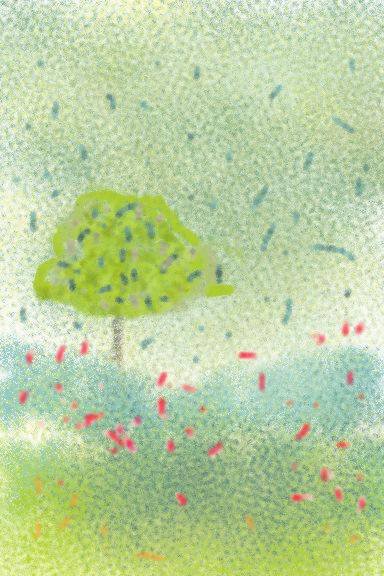
Beauty ablaze
The mountain stands resolute
Yellow sunshine floods the meadows down
Misty valleys caress the distant peaks
Sun and clouds play hide and seek
Hearing the stone speak
Fortified
Wings stretched wide
Fly
Spanning the skies
The mind alight
Capture the dauntless majesty
Of the cliff aloft
Panning the horizon
the splendour of the mountain
Its sheer ferocity
At a window ledge
From the flitting chink
Wandering wild
Drenched in the glimpse of eternity
The mountain stands resolute
Yellow sunshine floods the meadows down
Misty valleys caress the distant peaks
Sun and clouds play hide and seek
Hearing the stone speak
Fortified
Wings stretched wide
Fly
Spanning the skies
The mind alight
Capture the dauntless majesty
Of the cliff aloft
Panning the horizon
the splendour of the mountain
Its sheer ferocity
At a window ledge
From the flitting chink
Wandering wild
Drenched in the glimpse of eternity
Sunday, April 02, 2006
The Play
The conch shell dazzles
Across the fine grooves
There is an unfailing sheen
As the play begins
At the ocean shores
The cradle begins to rock
A melody rises deep
And we fall asleep
When the dice is played
When the puzzle unveils
When the cards are thrown
And the dart lunges forth
Awash with sheets of crystals
There are leaves on the ground
From the emerald ponds deep
The blue lilies arise
The fine sands slip away
Stars rush from above
Who was looking for us this while?
There is gold dust all over.
Across the fine grooves
There is an unfailing sheen
As the play begins
At the ocean shores
The cradle begins to rock
A melody rises deep
And we fall asleep
When the dice is played
When the puzzle unveils
When the cards are thrown
And the dart lunges forth
Awash with sheets of crystals
There are leaves on the ground
From the emerald ponds deep
The blue lilies arise
The fine sands slip away
Stars rush from above
Who was looking for us this while?
There is gold dust all over.
Sunday, March 26, 2006

Sunday, March 19, 2006
A Tree
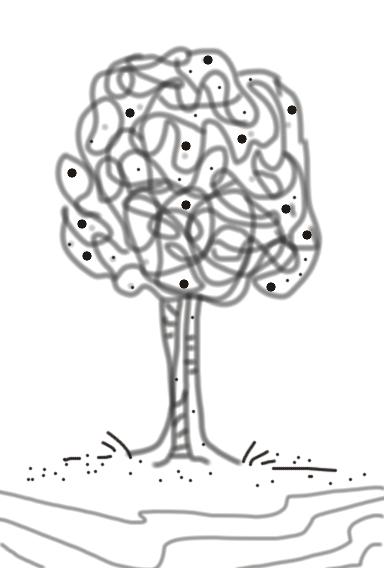
A tree beside the sandy
River-beach
Holds up its topmost boughs
Like fingers towards the skies
They cannot reach,
Earth-bound, heaven-amorous.
This is the soul of man.
Body and brain
Hungry for earth
our heavenly flight detain.
Sri Aurobindo
River-beach
Holds up its topmost boughs
Like fingers towards the skies
They cannot reach,
Earth-bound, heaven-amorous.
This is the soul of man.
Body and brain
Hungry for earth
our heavenly flight detain.
Sri Aurobindo
Monday, March 06, 2006
Nāgārjuna: Speech or Silence?
It is in impinging on a severe critique of language that the central upshot of the Mādhyamika method emerges. The rejection of language has its kernel in the idea of Pratītyasamutpāda and śūnyatā together, and witnesses an explicit articulation in the prasanga method of the Mādhyamika. Pratītyasamutpāda or conditioned emergence shows that everything is dependent on numerous contingent factors, modes and reasons, for their relative existence. All events come into being depending on their preceding conditions. So, none of them in isolation have independent essence or being. In characterizing all categories and all existents as finally “empty” or śūnya, what Mādhyamikas mean is that they are empty of “essence” or svabhāva. Śūnyatā is thus, the natural outcome of pratītyasamutpāda because upon the knowledge of the flux of reality, when one begins to unravel the object, one finds it to be empty of inherent existence or self-nature, devoid of any essential being.
In the Milindapañha for instance, Nāgasena poses as to ‘what a chariot is’ and then himself enumerates his proposals — is it the pole, the axle, the wheel, the reins etc? Or a mere conglomeration? And in refusing these unsatisfactory suggestions, King Milinda reaches the baffling conclusion that none of these individually or cumulatively constitutes the chariot, and that when it is unraveled to its core, it no more remains a chariot. The analogy can be extended to simply everything. It turns out that on analyzing reality free of any specific ditthi or perspective, we see that concepts characteristically fail and language distorts. Evidently, this is the harshest possible criticism against language, to deny its very function of even being able to express anything. Further, the method of reductio ad absurdum or prasanga is Nāgārjuna’s methodological core, in demonstrating that all possible perspectives [in language] about reality involve inherent self contradiction. The structure of the prasanga argument is four-fold, namely it is a four-cornered negation of the form of catuśkoti or tetralemma:
 I. A is [sad]
II. A is not [asad]
III. A both is and is not [ubhaya]
IV. A neither is nor is not [anubhaya]
This formulation exhausts the limit of all ‘meaningful’ thought or talk. By showing that all four alternatives are equally inconsistent by explicitly drawing out their implications, Nāgārjuna is able to point at the absurdity of language.
In picking from here, in the Vigrahavyāvartanī, the Nyāya school puts forth a number of objections against Nāgārjuna’s emphasis on śūnyatā, since the very espousal of śūnyatā itself presupposes language. Since, śūnyatā is framed in language, either, (a) śūnyatā itself is not śūnya, which would make the proposition that ‘everything is śūnya false’ or (b) if śūnyatā is śūnya, then the proposition is insignificant, meaningless, trivial or worthless, for it is simply empty of substance. Nāgārjuna however resorts to a rather confident defence in denying entirely that he is offering any thesis or ditthi.
Thus, in Vigrahavyāvartāni, Nāgārjuna says:
“If I had any proposition (pratijñā), then this defect (dosa) would be mine.
I have, however, no proposition. Therefore there is no defect that is mine.” [#29]
In the claim of a ‘no-position’ view of self refutation, the role of language seems to be radically inconsistent. To the extent that the claim is that one is not taking any metaphysical position at all, Nāgārjuna’s philosophy is śūnya too. This emptiness, best shown through silence, is realized when assent is withheld from all four logically possible answers to a metaphysical question (yes, no, both, neither). This is suggestive of the primal absurdity of speech and verbalization [prapañca]. The silence that is entailed, can be seen as a deconstruction of language itself, since language, here, is both used and negated in the same stroke. Is there a way then to resolve the inconsistency at a basic level?
In the backdrop of contemporary ordinary language philosophy, there is a visible turn towards stressing on the pragmatism in language. In his classic work How To Do Things With Words (1962), J. L. Austin makes the significant distinction between ‘performatives’ and ‘constatives’ and highlights the role of speech act as lying not in describing anything but in the doing of things. Essentially, speech acts refer to acts performed when words are uttered. Thus in a speech act, one does not seek to describe or report anything. It is about what is done in the saying of something, such as an active function as affirming, reassuring, promising, commanding, threatening or praying. That is, the utterance performs a function. Thus in saying ‘I promise’ in suitable circumstances I make a promise; in saying ‘Hooray!’ I cheer someone. Extending the idea of speech acts to Nāgārjuna’s method, one may argue that in suggesting the śūnyatā of everything, for instance, Nāgārjuna in the strict sense, is not just 'saying' anything. It looks like Nāgārjuna is rather engaged in doing [rather ‘undoing’] something. He is unravelling philosophical discourse to expose its inherent contradictions. He is also employing the speech act in affecting the hearer, since in claiming radically that everything is śunya, he annoys, puzzles, frustrates, and even disappoints the audience. It is transformative in its affecting the person or community in some way: purifying, healing, reconciling, protecting, informing, and so on. If the seeker of freedom understands the import of the utterances, then in the same act, she is also liberated, for she is moved, convinced, persuaded and then ‘quietened’. Nāgārjuna can thus defend his stance as using language in order to do something, not to describe anything (which is to be rendered true or false). In fact it is in the undoing of the theoretical effects of language that the Mādhyamika’s concern lies. Thus, Nāgārjuna’s use of language is possibly analogous to Derrida’s ‘writing under erasure’. The performative dimension of language then is something that seems fundamental to the Mādhyamika method. And on this interpretation perhaps, the apparent paradox of language and silence is resolved to an extent.
In the claim of a ‘no-position’ view of self refutation, the role of language seems to be radically inconsistent. To the extent that the claim is that one is not taking any metaphysical position at all, Nāgārjuna’s philosophy is śūnya too. This emptiness, best shown through silence, is realized when assent is withheld from all four logically possible answers to a metaphysical question (yes, no, both, neither). This is suggestive of the primal absurdity of speech and verbalization [prapañca]. The silence that is entailed, can be seen as a deconstruction of language itself, since language, here, is both used and negated in the same stroke. Is there a way then to resolve the inconsistency at a basic level?
In the backdrop of contemporary ordinary language philosophy, there is a visible turn towards stressing on the pragmatism in language. In his classic work How To Do Things With Words (1962), J. L. Austin makes the significant distinction between ‘performatives’ and ‘constatives’ and highlights the role of speech act as lying not in describing anything but in the doing of things. Essentially, speech acts refer to acts performed when words are uttered. Thus in a speech act, one does not seek to describe or report anything. It is about what is done in the saying of something, such as an active function as affirming, reassuring, promising, commanding, threatening or praying. That is, the utterance performs a function. Thus in saying ‘I promise’ in suitable circumstances I make a promise; in saying ‘Hooray!’ I cheer someone. Extending the idea of speech acts to Nāgārjuna’s method, one may argue that in suggesting the śūnyatā of everything, for instance, Nāgārjuna in the strict sense, is not just 'saying' anything. It looks like Nāgārjuna is rather engaged in doing [rather ‘undoing’] something. He is unravelling philosophical discourse to expose its inherent contradictions. He is also employing the speech act in affecting the hearer, since in claiming radically that everything is śunya, he annoys, puzzles, frustrates, and even disappoints the audience. It is transformative in its affecting the person or community in some way: purifying, healing, reconciling, protecting, informing, and so on. If the seeker of freedom understands the import of the utterances, then in the same act, she is also liberated, for she is moved, convinced, persuaded and then ‘quietened’. Nāgārjuna can thus defend his stance as using language in order to do something, not to describe anything (which is to be rendered true or false). In fact it is in the undoing of the theoretical effects of language that the Mādhyamika’s concern lies. Thus, Nāgārjuna’s use of language is possibly analogous to Derrida’s ‘writing under erasure’. The performative dimension of language then is something that seems fundamental to the Mādhyamika method. And on this interpretation perhaps, the apparent paradox of language and silence is resolved to an extent.
Saturday, March 04, 2006
Alterity or Subjectivity
An anti thesis of Kierkegaard’s view that truth is subjectivity is found perhaps in the post modern philosopher Levinas for whom alterity or ‘the Other’ is the ‘nude’ truth which when confronted ruptures the self. Through the face of alterity God is reached.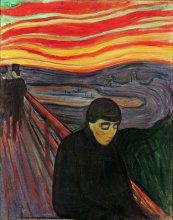 In his Beyond Intentionality Levinas says: ‘The face ‘signifies’ beyond, neither as an index nor as symbol, but precisely and irreducibility as a face that summons me. It signifies to-God (à Dieu), not as sign, but as the questioning of myself, as if I were summoned or called, that is to say, awakened or cited as myself’. Throughout the history of philosophy ‘the Other’ has been reduced to ‘the Same’ in its drive to objectify and universalize. For Levinas, the dominance of ‘the Same’ makes the universal the goal of thought.
So it turns out that Levinas is precisely against the same universalization and objectification that Kierkegaard is standing against. However, while for Kierkegaard the personal subject confers itself its own identity, standing as the primal individual; in Levinas, through language, it is ‘the Other’ that enables me to have an identity. Language is the basis which links us to other people. The signifier then is the opening up to ‘the Other’. It is in confronting the irreducible ‘Other’, seeing time as alterity, existence as alterity, the other person (autrui) as alterity, language as alterity, and God as alterity that we are led away from ontology, epistemology and reason, to the realm of ethics and religion. The shift then is from discourses that compel homogenous levelling to ones that heighten fecund encounters with the different Other.
 In his Beyond Intentionality Levinas says: ‘The face ‘signifies’ beyond, neither as an index nor as symbol, but precisely and irreducibility as a face that summons me. It signifies to-God (à Dieu), not as sign, but as the questioning of myself, as if I were summoned or called, that is to say, awakened or cited as myself’. Throughout the history of philosophy ‘the Other’ has been reduced to ‘the Same’ in its drive to objectify and universalize. For Levinas, the dominance of ‘the Same’ makes the universal the goal of thought.
So it turns out that Levinas is precisely against the same universalization and objectification that Kierkegaard is standing against. However, while for Kierkegaard the personal subject confers itself its own identity, standing as the primal individual; in Levinas, through language, it is ‘the Other’ that enables me to have an identity. Language is the basis which links us to other people. The signifier then is the opening up to ‘the Other’. It is in confronting the irreducible ‘Other’, seeing time as alterity, existence as alterity, the other person (autrui) as alterity, language as alterity, and God as alterity that we are led away from ontology, epistemology and reason, to the realm of ethics and religion. The shift then is from discourses that compel homogenous levelling to ones that heighten fecund encounters with the different Other.
However, Kierkegaard’s rigid persistence on the priority of the isolated individual per se can be made sense of, by the fact that his reaction is rooted in the context of the widespread, overpowering, overarching structures propagating universality, objectivity, abstractions, absolutism and stereotypes. Strictly speaking, one is just an individual for whom other’s existence occurs as a mere possibility, never a concrete actual. What exists comes first. It is my existence that is truly actual and concrete for me. It is therefore that Kierkegaard, in his solitary confrontation against depersonalization, anonymous public opinion, and mass consciousness, sought to become what he wanted to be known as: that individual”.
(Painting: Edward Munch - Despair 1893-94)
Sunday, January 08, 2006
Resurgence
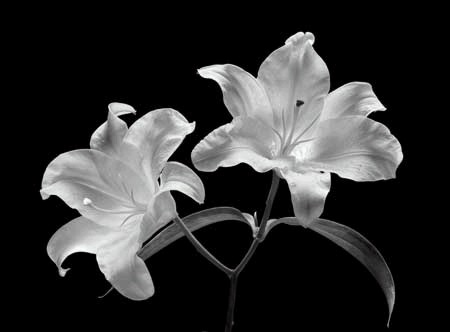 "To see a world in a grain of sand
And heaven in a wild flower
Hold infinity in the palm of your hand
And eternity in an hour."
William Blake
Auguries of Innocence
The World and the Earth
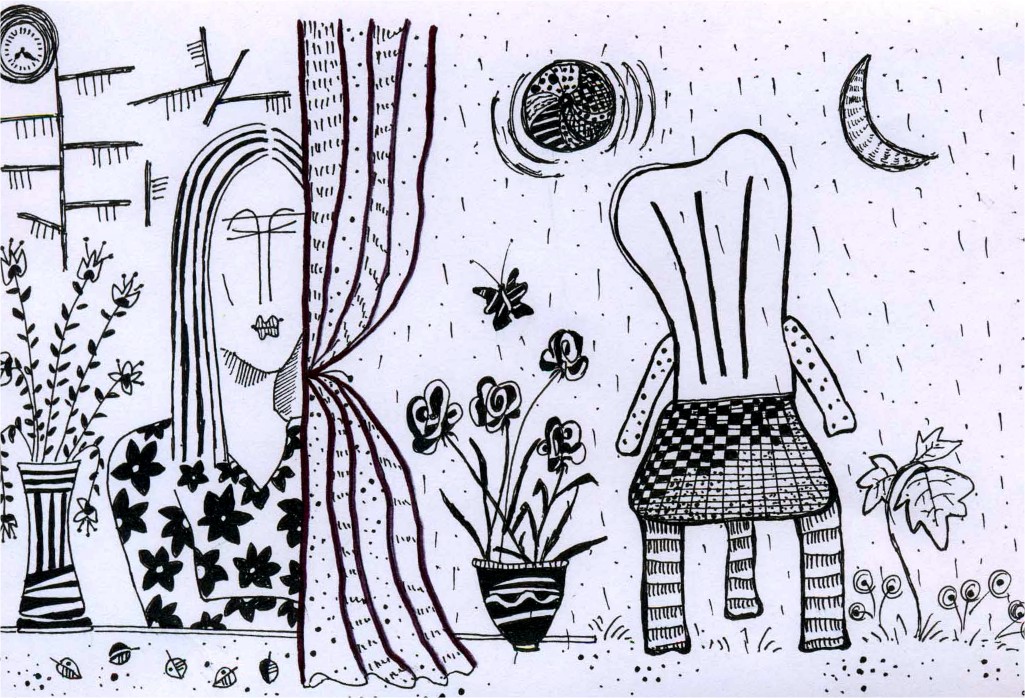
Heidegger, Sartre, and Levinas all consider the ontology of art and the different ways in which art and language create new perspectives on reality. Heidegger in his essay ‘The Origin of the Work of Art’ claims that a work of art brings a world into view. He discusses art in terms of truth and his idea of disclosure. Heidegger’s draws upon the ancient Greek concept of truth as aletheia, which means ‘the unconcealedness of beings’. As a concept of truth, it is distinct from and logically prior to our conventional, Roman notion of truth as veritas or ‘correspondence with the facts’. For there to be any objects to make up states of affairs to which our statements can correspond, there must be the ‘truth’ which lets these objects first come to be.
Art is true, Heidegger claims, in that it lets us see the tension between concealment and disclosure. He calls this ‘the conflict of world and earth’: ‘world’ is used in the sense that any disclosure is the opening of a realm, e. g., the realm of sight, and ‘earth’ is the concealed domain from which the world emerges. The artwork ‘moves the earth itself into the Open of a world and keeps it there’. A Greek temple, Heidegger suggests, opens a world by creating a ‘relational context’, of ‘birth and death, disaster and blessing, victory and disgrace, endurance and decline’, and Van Gogh’s painting of a peasant’s shoes brings out the use-life which the shoes have for their owner, what Heidegger calls ‘the equipmentality of equipment’. We experience the aletheic truth of art as a form of ‘thatness’. We might not be able to say what it is about a work that impresses us, but that there is something there we are certain of. A sense of ‘thatness’ stands out, stops us in our tracks. This is consistent with Kant’s proposal that it is part of the experience of art for us to be motivated to find new words to describe the experience. Ultimately, for Heidegger, ‘the nature of art is poetry’. He proposes that art is truest, at its most aletheic, when it is poetic.
[From Cazeaux, Clive, Continental Aesthetics Reader, Florence, KY, USA: Routledge, 2000]
Friday, December 16, 2005
The Divided Line in Art
"Why are numbers beautiful? It's like asking why is Beethoven's Ninth Symphony beautiful. If you don't see why, someone can't tell you. I know numbers are beautiful. If they aren't beautiful, nothing is."
Hungarian mathematician Paul Erdös thus articulated his view on the sheer aesthetic of mathematics. Theories of art centrally rely on the idea of beauty which is usually characterized as the 'perception of balance and proportion of stimulus, harmony of form, rhythm or colour, fineness of artistic quality, candour, and originality'. It is the conception of such a symmetric, perfect, consistent harmonious world that the Pythagoreans conceived of through numbers.
For Plato, art is unreal appearance, because it lies in the realm of perception, changing, disintegrating in the world, almost like illusions. He says all this because he already has a framework of reality in mind, that is, ultimately reality is that which is invariant, spaceless, timeless, consisting of absolute essences. The unreality of art comes from the fact of its change, and further, from Plato’s view that what is seen is ultimately unreal. In contrast, mathematical truths are ever real because they are unperceived, pure and sublime, not vitiated by errors.
The object of art, like numbers, is abstract. In The Imaginary, Sartre speaks of the aesthetic object as the irreal. He points out that it is a mistake to think that the artist “realizes” a pre-conceived mental image onto the canvas. Rather, Sartre claims:
“What is real…are the results of the brush strokes, the impasting of the canvas, its grain, the varnish spread over the colours. But precisely, all this is not the object of aesthetic appreciation. What is ‘beautiful’, on the contrary, is a being that cannot be given to perception and that, in its very nature, is isolated from the universe.”
Further he says that the painting is simply an analogue for one to be able to construe the object of beauty, that is, the irreal whole. Clearly then Sartre has turned the talk around. He seems to be claiming that the real is in fact the physical painting. But certainly, it is not that we are engaged with when enjoying a work of art. That which is the object of our aesthetic muse is simply never the ‘real’ paint, strokes, grain of canvas, i.e. nothing of the physically perceived senses as colors, textures, etc. It consists in an entirely abstract, irreal object that is pointed towards by the actual painting. There may be nothing specific that can be pointed at to define a common notion of art. And yet, it does not follow that there is no notion of beauty or art that we can work with, which makes that what art is. This is exactly because some things do show up as works of art as against others.
What then is the criterion of art? In what way would be art accessible to us? How should we view art? If it is an abstraction, is it even worth nurturing? The question of the use value of art has been grappled with a phenomenal concern. In lashing out against such pragmatic anxieties, Oscar Wilde, long since engaged in decadent movements, famously quipped "All art is quite useless". He was, of course, a strong champion of "Art for art's sake" (l’art pour l’art) in defiance of those who felt that the value of art lay in serving some moral or didactic purpose, as social utility, etc. The view of art for art's sake reinforced that art was valuable as art, that artistic pursuits were self justified, and that art did not need moral justification — and in fact, was free even to be morally subversive.
Now, when does something turn into a work of art?
Marcel Duchamp, perhaps one of the most important influences the post-war art scene, co-founder of a Dada group, was one of the first artists to use commonplace objects, readymades, as the basis for his artworks. His controversial work Fountain is a clear case that interrogates the conventional notions of art. Andy Warhol's Campbell's Soup Can is another stunning break from convention, in constructing the idiom of the pop where his works profusely used dollar bills, soup cans, posters, soft-drink bottles, and garish nylon fibres. Art now seemed to have even lost the accompanying mark of artistic methods, tools and skill, employing techniques of commercial art and advertising, and thus giving a blow to the accentuated pretence of a high-culture versus low-culture chasm.
In a self styled remark he said, "If you want to know all about Andy Warhol, just look at the surface of my paintings and films and me, and there I am. There's nothing behind it." The “superficiality” is the point of Warhol’s works. He brings forth a certain anti essentialist position on what art means to him, in his emphasis on rejecting the narrative of the concealed reality of art, the work of art and the artist. No attempt is made at analysing the subjective pathos, the intention or emotion of the artist.
By the last account it seems that nothing apart from the surface and the objects was art. In a way, we come full circle, for art for Plato too is in the realm of the sensible, i.e. in the world of change. Yet in another sense this is perhaps the total antithesis of a Plato’s dream to separate the invisible/intelligible and the visible/sensible, to separate the world of abstract forms [such as Beauty] and particular objects that may be beautiful, to separate the mind and the body, to separate the original and the copy, and so on. Whether or not there are essences to art, as the form of Beauty [cf. Plato’s Phaedo] or some archetype of symmetry, harmony, etc., are questions that would simply be irrelevant on the pop account of art.
Extending this line, Jean Baudrillard brings in the imaginative notion of hyperreality to explain how things are, in his Simulacra and Simulation. The idea of simulacrum would roughly be ‘a copy of a copy which has been so dissipated in its relation to the original that it can no longer be said to be a copy’. The simulacrum referred to are signs of culture technology and media that create the reality that we perceive, surviving on its own as a copy without a model. The 1999 movie The Matrix was based on this view of Baudrillard’s simulated world as being more real than the ‘real’ world.
In The Transparency of Evil (1993), Baudrillard speaks of a situation called ‘transaesthetics’ in which the so-called independent and isolated spheres of economy, art, politics, and culture, inter-penetrate each other. He claims that art has entered all facets of existence. Thus, the expectation of the avant-garde for art to inform life [cf. Oscar Wilde’s quip ‘Life imitates Art’] has been, in many ways, already fulfilled. Yet, this precisely means that in the incorporation and proliferation of art in everyday life, art itself as an independent and transcendent phenomenon has vanished. ‘Reality is therefore just another TV channel’. Interestingly, Baudrillard makes use of Borges’ ironic fable of an empire whose cartographers create a map so minutely detailed that it covers the very things it was intended to represent. That is, the map turns out to be as large as the kingdom itself, to the scale! Now, when the empire declines, the map recedes into the landscape and there is neither the simulated copy or representation, nor is it the originally real that remains – but just the hyperreal.
Hungarian mathematician Paul Erdös thus articulated his view on the sheer aesthetic of mathematics. Theories of art centrally rely on the idea of beauty which is usually characterized as the 'perception of balance and proportion of stimulus, harmony of form, rhythm or colour, fineness of artistic quality, candour, and originality'. It is the conception of such a symmetric, perfect, consistent harmonious world that the Pythagoreans conceived of through numbers.
For Plato, art is unreal appearance, because it lies in the realm of perception, changing, disintegrating in the world, almost like illusions. He says all this because he already has a framework of reality in mind, that is, ultimately reality is that which is invariant, spaceless, timeless, consisting of absolute essences. The unreality of art comes from the fact of its change, and further, from Plato’s view that what is seen is ultimately unreal. In contrast, mathematical truths are ever real because they are unperceived, pure and sublime, not vitiated by errors.
The object of art, like numbers, is abstract. In The Imaginary, Sartre speaks of the aesthetic object as the irreal. He points out that it is a mistake to think that the artist “realizes” a pre-conceived mental image onto the canvas. Rather, Sartre claims:
“What is real…are the results of the brush strokes, the impasting of the canvas, its grain, the varnish spread over the colours. But precisely, all this is not the object of aesthetic appreciation. What is ‘beautiful’, on the contrary, is a being that cannot be given to perception and that, in its very nature, is isolated from the universe.”
Further he says that the painting is simply an analogue for one to be able to construe the object of beauty, that is, the irreal whole. Clearly then Sartre has turned the talk around. He seems to be claiming that the real is in fact the physical painting. But certainly, it is not that we are engaged with when enjoying a work of art. That which is the object of our aesthetic muse is simply never the ‘real’ paint, strokes, grain of canvas, i.e. nothing of the physically perceived senses as colors, textures, etc. It consists in an entirely abstract, irreal object that is pointed towards by the actual painting. There may be nothing specific that can be pointed at to define a common notion of art. And yet, it does not follow that there is no notion of beauty or art that we can work with, which makes that what art is. This is exactly because some things do show up as works of art as against others.
What then is the criterion of art? In what way would be art accessible to us? How should we view art? If it is an abstraction, is it even worth nurturing? The question of the use value of art has been grappled with a phenomenal concern. In lashing out against such pragmatic anxieties, Oscar Wilde, long since engaged in decadent movements, famously quipped "All art is quite useless". He was, of course, a strong champion of "Art for art's sake" (l’art pour l’art) in defiance of those who felt that the value of art lay in serving some moral or didactic purpose, as social utility, etc. The view of art for art's sake reinforced that art was valuable as art, that artistic pursuits were self justified, and that art did not need moral justification — and in fact, was free even to be morally subversive.
Now, when does something turn into a work of art?
Marcel Duchamp, perhaps one of the most important influences the post-war art scene, co-founder of a Dada group, was one of the first artists to use commonplace objects, readymades, as the basis for his artworks. His controversial work Fountain is a clear case that interrogates the conventional notions of art. Andy Warhol's Campbell's Soup Can is another stunning break from convention, in constructing the idiom of the pop where his works profusely used dollar bills, soup cans, posters, soft-drink bottles, and garish nylon fibres. Art now seemed to have even lost the accompanying mark of artistic methods, tools and skill, employing techniques of commercial art and advertising, and thus giving a blow to the accentuated pretence of a high-culture versus low-culture chasm.
In a self styled remark he said, "If you want to know all about Andy Warhol, just look at the surface of my paintings and films and me, and there I am. There's nothing behind it." The “superficiality” is the point of Warhol’s works. He brings forth a certain anti essentialist position on what art means to him, in his emphasis on rejecting the narrative of the concealed reality of art, the work of art and the artist. No attempt is made at analysing the subjective pathos, the intention or emotion of the artist.
By the last account it seems that nothing apart from the surface and the objects was art. In a way, we come full circle, for art for Plato too is in the realm of the sensible, i.e. in the world of change. Yet in another sense this is perhaps the total antithesis of a Plato’s dream to separate the invisible/intelligible and the visible/sensible, to separate the world of abstract forms [such as Beauty] and particular objects that may be beautiful, to separate the mind and the body, to separate the original and the copy, and so on. Whether or not there are essences to art, as the form of Beauty [cf. Plato’s Phaedo] or some archetype of symmetry, harmony, etc., are questions that would simply be irrelevant on the pop account of art.
Extending this line, Jean Baudrillard brings in the imaginative notion of hyperreality to explain how things are, in his Simulacra and Simulation. The idea of simulacrum would roughly be ‘a copy of a copy which has been so dissipated in its relation to the original that it can no longer be said to be a copy’. The simulacrum referred to are signs of culture technology and media that create the reality that we perceive, surviving on its own as a copy without a model. The 1999 movie The Matrix was based on this view of Baudrillard’s simulated world as being more real than the ‘real’ world.
In The Transparency of Evil (1993), Baudrillard speaks of a situation called ‘transaesthetics’ in which the so-called independent and isolated spheres of economy, art, politics, and culture, inter-penetrate each other. He claims that art has entered all facets of existence. Thus, the expectation of the avant-garde for art to inform life [cf. Oscar Wilde’s quip ‘Life imitates Art’] has been, in many ways, already fulfilled. Yet, this precisely means that in the incorporation and proliferation of art in everyday life, art itself as an independent and transcendent phenomenon has vanished. ‘Reality is therefore just another TV channel’. Interestingly, Baudrillard makes use of Borges’ ironic fable of an empire whose cartographers create a map so minutely detailed that it covers the very things it was intended to represent. That is, the map turns out to be as large as the kingdom itself, to the scale! Now, when the empire declines, the map recedes into the landscape and there is neither the simulated copy or representation, nor is it the originally real that remains – but just the hyperreal.
This appeared in Vista 2005, Fine Arts Society Journal, St. Stephen's College.
Monday, December 12, 2005
The Window
The ivory porcelain
Stands over the mahogany table
Across the window
Raindrops
Sticking onto glass panes
Glistening film of a clear curve
The shimmer lingers on
Blooms of lilies sway
Rock in the frosty breeze
Dew like gold dust
Even as I stray radiant
Into warm velvety shadows
I swim
Whirl
Into the kingdom of delight.
Stands over the mahogany table
Across the window
Raindrops
Sticking onto glass panes
Glistening film of a clear curve
The shimmer lingers on
Blooms of lilies sway
Rock in the frosty breeze
Dew like gold dust
Even as I stray radiant
Into warm velvety shadows
I swim
Whirl
Into the kingdom of delight.
Tuesday, December 06, 2005

Wednesday, November 23, 2005
JABBERWOCKY
`Twas brillig, and the slithy toves
Did gyre and gimble in the wabe:
All mimsy were the borogoves,
And the mome raths outgrabe.
Lewis Carroll
(from Through the Looking-Glass and What Alice Found There, 1872)
Did gyre and gimble in the wabe:
All mimsy were the borogoves,
And the mome raths outgrabe.
Lewis Carroll
(from Through the Looking-Glass and What Alice Found There, 1872)
Wednesday, November 09, 2005
Chase
07.04.2002
Through light grey
Pencil marks
I browse, I flip, I search
Forward and back
And in the margins
I survey close
Hard. Again. Harder
Utmost focus
Concentration of walking a tight rope
Drops of glistening sweat
Garland my brows
My veins turn taut
I get desperate
Irritated, annoyed
With a sense of loss
It keeps echoing
‘why is it evading me?’
Elusive
Moments pass
With renewed vigour
I search afresh
Give it a last try
Scrutinize, probe
Deep, deeper
I check thoroughly
Frantically
And then
In a sheer moment
As it stares blunt
Blatant on my face
I overlook it
I turn the page
With no sense of loss.
Through light grey
Pencil marks
I browse, I flip, I search
Forward and back
And in the margins
I survey close
Hard. Again. Harder
Utmost focus
Concentration of walking a tight rope
Drops of glistening sweat
Garland my brows
My veins turn taut
I get desperate
Irritated, annoyed
With a sense of loss
It keeps echoing
‘why is it evading me?’
Elusive
Moments pass
With renewed vigour
I search afresh
Give it a last try
Scrutinize, probe
Deep, deeper
I check thoroughly
Frantically
And then
In a sheer moment
As it stares blunt
Blatant on my face
I overlook it
I turn the page
With no sense of loss.
Sunday, November 06, 2005
Playing the Lilt
Lilt of mind in the ascent beyond
I am the voyage
The blossom springs
I turn inside
In the emerald lake
As the swans glide across
In a slender arc
I weave gold
In the flowing crimson silk
The threads twirl
While the lotus unfolds
At the game of chess
I make a move.
I am the voyage
The blossom springs
I turn inside
In the emerald lake
As the swans glide across
In a slender arc
I weave gold
In the flowing crimson silk
The threads twirl
While the lotus unfolds
At the game of chess
I make a move.
Friday, November 04, 2005
"Time present and time past
Are both perhaps present in time future
And time future contained in time past."
Time past and time future
What might have been and what has been
Point to one end, which is always present.
What we call the beginning is often the end
And to make an end is to make a beginning.
The end is where we start from.
If you came this way,
Taking any route, starting from anywhere,
At any time or at any season,
It would always be the same.
A fourth dimension of aesthetic sense
Where all is in ourselves, ourselves in all.
(From The Four Quartets: TS Eliot)
Are both perhaps present in time future
And time future contained in time past."
Time past and time future
What might have been and what has been
Point to one end, which is always present.
What we call the beginning is often the end
And to make an end is to make a beginning.
The end is where we start from.
If you came this way,
Taking any route, starting from anywhere,
At any time or at any season,
It would always be the same.
A fourth dimension of aesthetic sense
Where all is in ourselves, ourselves in all.
(From The Four Quartets: TS Eliot)
Waiting for Godot
VLADIMIR: We can still part, if you think it would be better.
ESTRAGON: It's not worthwhile now.
Silence.
VLADIMIR: No, it's not worthwhile now.
Silence.
ESTRAGON: Well, shall we go?
VLADIMIR: Yes, let's go.
They do not move.
Curtain.
ESTRAGON: It's not worthwhile now.
Silence.
VLADIMIR: No, it's not worthwhile now.
Silence.
ESTRAGON: Well, shall we go?
VLADIMIR: Yes, let's go.
They do not move.
Curtain.
Waiting for Godot
Samuel Beckett
Samuel Beckett
Friday, October 28, 2005
Jonathan Livingston Seagull
To the real Jonathan Seagull,
who lives within us all.
"It was morning, and the new sun sparkled gold across the ripples of a gentle sea. A mile from shore a fishing boat chummed the water. and the word for Breakfast Flock flashed through the air, till a crowd of a thousand seagulls came to dodge and fight for bits of food. It was another busy day beginning. But way off alone, out by himself beyond boat and shore, Jonathan Livingston Seagull was practicing. A hundred feet in the sky he lowered his webbed feet, lifted his beak, and strained to hold a painful hard twisting curve through his wings. The curve meant that he would fly slowly, and now he slowed until the wind was a whisper in his face, until the ocean stood still beneath him. He narrowed his eyes in fierce concentration, held his breath, forced one... single... more... inch...of... curve... Then his featliers ruffled, he stalled and fell. Seagulls, as you know, never falter, never stall. To stall in the air is for them disgrace and it is dishonor. But Jonathan Livingston Seagull, unashamed, stretching his wings again in that trembling hard curve - slowing, slowing, and stalling once more - was no ordinary bird. Most gulls don't bother to learn more than the simplest facts of flight - how to get from shore to food and back again. For most gulls, it is not flying that matters, but eating. For this gull, though, it was not eating that mattered, but flight. More than anything else. Jonathan Livingston Seagull loved to fly."
Tuesday, October 25, 2005
Monday, October 10, 2005
Kierkegaard's Passion
Kierkegaard's passion was not about a staunch, certain and blind belief in a truth called God. It was rather about clinging on to the uncertainty of it all post reflection, and to reaffirm one's authenticity in taking the leap of faith. If Kierkegaard is seen at the root of Existentialist thought, it is because of his emphasis upon the individual whose lived experiences are most important, and because of the strong notion of freedom that a person possesses in existing and making alternative difficult choices.
The dilemma is that individuals are not sincere if they do not attempt to reflect on the relation between themselves and God. But when they indeed do, it turns out that they can never be certain about the phenomena, because God can never become the object, and therefore never accessible to the rational faculty; God is, indeed, the eternal subject. When the individual subject thus confronts this dilemma, (s)he suffers from the agony of uncertainty. And yet this uncertainty must be held fast onto with the greatest passion. The uncertainty of the possible brings with it the suffering that a truly existing human being is conscious of, as a mark of taking upon complete responsibility of choice. Kierkegaard's remedy is hardly the average person's cup of tea. But for him the ethically responsible persons would turn 'inward' and go through this if they thought of themselves as being true to the spirit of Christianity.
Clearly, Kierkegaard's bitter polemic was both against the institutionalized religion of the Church and society which offered a platter full of absolutist, certain and dogmatic Christian doctrines, to be followed uncritically, scientifically and generally. In sharp contrast, Kierkegaard felt that in truth, we strictly are individuals who cannot be treated mediately or like objects at all. We must simply not be part of these sheep-like herds (as community, race, society, etc). We must stand out by being aware of our existence. Thus, Kierkegaard's other adversary was the worldview of the Hegelian Absolute, that totally subsumed the individual's subjective reality under the Objective Spirit or Geist.
Clearly, Kierkegaard's bitter polemic was both against the institutionalized religion of the Church and society which offered a platter full of absolutist, certain and dogmatic Christian doctrines, to be followed uncritically, scientifically and generally. In sharp contrast, Kierkegaard felt that in truth, we strictly are individuals who cannot be treated mediately or like objects at all. We must simply not be part of these sheep-like herds (as community, race, society, etc). We must stand out by being aware of our existence. Thus, Kierkegaard's other adversary was the worldview of the Hegelian Absolute, that totally subsumed the individual's subjective reality under the Objective Spirit or Geist.
Tuesday, October 04, 2005

Thursday, September 29, 2005
Kuhn’s Road Since Structure
In Structure of Scientific Revolutions, Thomas S. Kuhn introduced the single most striking concept of "paradigm" into the discourse of Philosophy of Science, which people of a set or community shared. Thirty years after, in a paper titled "The Road since Structure", Kuhn seems to make an attempt to go beyond this model by revisiting and exploring the structures behind paradigms themselves. Of course, his central concerns in general are again: rationality, relativism, realism and truth, but most crucially he formulates the idea of incommensurability as fundamental to the viewing and understanding of scientific knowledge. Kuhn traces the evolution of incommensurability from the period when there were attempts to understand apparently nonsensical passages in old scientific texts, ordinarily taken to be confused or mistaken beliefs, and therefore taken to be incommensurable. However, it was later realized that this apparent nonsense could be wholly removed by recovering the old meanings that were indeed remarkably different. Metaphorically, Kuhn explained this earlier, as a ‘process’ by which later meanings evolve from earlier ones with changes in language. But to be more specific, Kuhn adds that, in talking about scientific knowledge he is not really dealing with all general features of language as such but with meanings of a certain restricted class of terms. These are "taxonomic terms" or "kind terms" which include count nouns, mass nouns or classes- that take the indefinite article; in other words, the many classificatory systems that underlie scientific knowledge. The two properties that taxonomic terms or kind terms have are that they (i) take the indefinite article. It would thus be essential to know what the term applies to or its denotation, and (ii) work with the no- overlap principle, a certain ‘boundary definition’; which is to the effect that no two terms with a kind label, unless related as species to genus, can overlap. For example, things as dogs/cats/silver, etc. are all different from each other in kind because there is no overlap in their boundary definition. Kuhn points out that a "… lexical taxonomy of some sort must be in place before description of the world can begin..."(p.233, para 2). It is the shared lexical taxonomy that allows statements to be meaningful in a given discourse. What follows is that there is: (a) a presupposed lexical taxonomy, (b) which is shared (c) for unproblematic and meaningful communication. Community discourse is thus always context specific. Statements and theories are always situated within a specific taxonomy and they are both developed and validated/or rejected in that scheme. Two examples that Kuhn offers to illustrate his idea are: one, the untranslatability of the English phrase "the cat sat on the mat" into French owing to taxonomical difficulties, (that there really is no French counterpart to the term "mat" in English); and two, the Copernican statement "planets travel around the sun" cannot be expressed in a lexical structure which works with the taxonomy of the Ptolemaic statement "planets travel around the earth" (p.234). Kuhn asserts that lexical taxonomy roughly means a conceptual scheme that is not tied to a ‘set of belief’ but is of a ‘mental module’ , which is the very pre-requisite to having certain beliefs and even being able to conceive them. Here, Kuhn appears to be accounting for what makes it possible to conceive things in a certain way, perhaps even the pre-linguistic structures and the visual and cognitive configurations that determine the way we see, know and understand. He further claims that violation of the no-overlap principle, etc. leads to incommensurability or untranslatability, "localized to one or another area in which two lexical taxonomies differ". This would mean that experience of world and its communication would necessarily take place within the structure of lexicon of a community. And it is virtually impossible to communicate all experience in its completeness across a lexical divide. When two different sets of taxonomies confront each other, the result is mutual incommensurability or untranslatability. Kuhn then locates incommensurability within a developmental framework (within which it appears) and subsequently charts the course of an evolutionary epistemology. He admits that in thinking that history functioned as source of empirical evidence, the empirical aspect had been exaggerated. Beliefs are already there, there is a process in progress. The pursuit of science is situated within this process and there was no need of empirical observation of actual practices to conclude this. This clearly undermines the foundationalist description of things. Another serious consequence that follows from the rejection of foundationalism is the dismissal of the correspondence theory of truth. Developmental view traces and evaluates scientific knowledge claims not from an ‘Archimedean platform’ but from a moving historically situated platform. It would be incorrect to evaluate a theory in isolation since theories are dependent and connected. The implication is that any new theory or proposition requires necessarily an adjustment with other beliefs. Comparative judgments are, then, to do with the question of "which one of two bodies of knowledge is better" for a given work. This would amount really to a pragmatic decision. Such judgments have, as given, shared beliefs as part of the historical situation. Their evaluation would not depend on their being in fact true/false. However, this also implies that the question of truth/falsity of the changes made/ or the rejection of the judgment on those accounts simply does not arise. Justification of a belief does not aim at a goal external to the historical situation, thus, questioning the very basis of correspondence theory. The aim rather is to improve the tools available for the work engaged in. The distinction between normal development and revolutionary development is what Kuhn draws upon, next. Outlining the parallels of biological evolution with scientific development, in so far as knowledge mutates and analogous speciation (creation of new disciplines, etc.) takes place, Kuhn stresses that in Structure, normal development was the development that added to existing knowledge while revolutionary development was a radical one that required giving up part of what had been believed before. In his fresh formulation, Kuhn seems to argue that revolutionary development is one that requires taxonomic changes, while normal development would be one that didn’t need any. He also asserts that more cognitive specialties or separate fields of knowledge arise, essentially at zones of lexical overlaps, each field being distinct in having developed a separate lexicon. Instead of a correspondence theory, Kuhn primarily argues for a redundancy theory of truth. In other words, now the essential function of truth involves choosing between acceptance and rejection of the statement/ theory in question in the face of ‘evidence shared by all’. There is increasing belief for Kuhn that his central points would be better formulated without speaking of statements as themselves being true/false. Instead, he offers an alternative two-fold evaluation to determine the status of any statement:
(i) This would involve asking: ‘Is the statement a possible candidate for truth/falsity?
(ii) If yes, ‘Is the statement rationally assertable?’
The answer to (ii) would be obviously answered by the normal ‘rules of evidence’ given a specific lexicon. Rules of evidence are laid down by the community sharing a lexical taxonomy.
To give an instance, Kuhn points out that the basic principle of non-contradiction is valued in discourses in one language game while there are exceptions to it in certain other language games. The violation of the principle of non-contradiction is well expressed, for instance, in "poetry and metaphysical discourse" and its exploitation is common and justified in use of "metaphors". Rules of truth/falsity game are universal and essentially human, although, the result of applying those rules would differ. What is stressed is that breakdowns in communication, termed "crises" (Structure), are in fact crucial symptoms of growth of knowledge and the emergence of new disciplines. Where there is stark untranslatability or incommensurability, there is a new lexical taxonomy in place. This new taxonomy results in a new discipline altogether. Kuhn maintains that the process of specialization imposes limitations on communication and community, making one field of knowledge inaccessible to another community which is unacquainted with that taxonomy. However, this limitation is inevitable owing to the necessary lexical divergence in the evolution of distinct fields. He is further led to argue that though lexical diversity amounts to: (a) a principled limit on communication and (b) a limited range of possible partners for a discourse, this is an essential precondition for any progress in knowledge. Kuhn is careful to ward off any attempt to conclude the world as being either mind dependent or an invention/construction. There are two reasons that he offers in his defence: one, the world is not invented or constructed because we find the world already there before us, it is ‘given’ to us and two, it is experientially both given directly and indirectly to us. It often goes against our wishes. There are many times, “decisive evidence against invented hypotheses". This is however not to deny that there is always scope for interaction, leading to alteration of both the member and the world it constitutes. The question whether it is the creatures who adapt to the world or the world adapts to creatures" (p.242, para 2) is one that is raised in this context. Kuhn observes, that the ‘world is our representation of our niche’, of a given interacting community. Clearly though, this is meant to counter any subjectivist interpretation. Even in talking of non overlapping lexical structures Kuhn is concerned with wanting to preserve something permanent, fixed, stable underlying difference and change. However, reiterating, as he puts it at the end, ‘Ways of being-in-the-world which lexicon provides are not candidates for truth or falsity'.
(i) This would involve asking: ‘Is the statement a possible candidate for truth/falsity?
(ii) If yes, ‘Is the statement rationally assertable?’
The answer to (ii) would be obviously answered by the normal ‘rules of evidence’ given a specific lexicon. Rules of evidence are laid down by the community sharing a lexical taxonomy.
To give an instance, Kuhn points out that the basic principle of non-contradiction is valued in discourses in one language game while there are exceptions to it in certain other language games. The violation of the principle of non-contradiction is well expressed, for instance, in "poetry and metaphysical discourse" and its exploitation is common and justified in use of "metaphors". Rules of truth/falsity game are universal and essentially human, although, the result of applying those rules would differ. What is stressed is that breakdowns in communication, termed "crises" (Structure), are in fact crucial symptoms of growth of knowledge and the emergence of new disciplines. Where there is stark untranslatability or incommensurability, there is a new lexical taxonomy in place. This new taxonomy results in a new discipline altogether. Kuhn maintains that the process of specialization imposes limitations on communication and community, making one field of knowledge inaccessible to another community which is unacquainted with that taxonomy. However, this limitation is inevitable owing to the necessary lexical divergence in the evolution of distinct fields. He is further led to argue that though lexical diversity amounts to: (a) a principled limit on communication and (b) a limited range of possible partners for a discourse, this is an essential precondition for any progress in knowledge. Kuhn is careful to ward off any attempt to conclude the world as being either mind dependent or an invention/construction. There are two reasons that he offers in his defence: one, the world is not invented or constructed because we find the world already there before us, it is ‘given’ to us and two, it is experientially both given directly and indirectly to us. It often goes against our wishes. There are many times, “decisive evidence against invented hypotheses". This is however not to deny that there is always scope for interaction, leading to alteration of both the member and the world it constitutes. The question whether it is the creatures who adapt to the world or the world adapts to creatures" (p.242, para 2) is one that is raised in this context. Kuhn observes, that the ‘world is our representation of our niche’, of a given interacting community. Clearly though, this is meant to counter any subjectivist interpretation. Even in talking of non overlapping lexical structures Kuhn is concerned with wanting to preserve something permanent, fixed, stable underlying difference and change. However, reiterating, as he puts it at the end, ‘Ways of being-in-the-world which lexicon provides are not candidates for truth or falsity'.
Saturday, September 17, 2005
Passion for the Possible
Edward Scissorhands: A robot-human who has the delicacy of a cherubic infant, the tender sensitivity of an angel and a sharp, huge pair of steel scissors for hands!The classic film titled ‘Edward Scissorhands’ tells the poignantly delightful story of such a robot-human, who is the miraculous creation of an aging scientist’s novel and striking ingenuity. Endowed already with penetrating human instincts, innocent curiosity and a child-like wonder, and intelligence, Edward is to be finally given a pair of well crafted hands in place of his scissors-hands. And in a dramatic stroke of misfortune, the old scientist falls dead of a heart attack at the moment of fitting those living hands. The muscle hands are ruined completely even as Edward struggles to hold them with his sharp edged blades, bruising himself as well. The rest of the story traces his life in an ordinary and normal colony of people who go on with their lives in the most uninteresting and uninspired manner, lacking in creative spirit and high on false pride. In contrast, Edward with his strange body is seen to have mastered the art of pruning, shaping, cutting, sculpting everything that falls in the way of his scissor-hands. The film simply stirs one in exploring the fantasy of possibilities. “But the fairy tale only invents what is not the case: it does not talk nonsense'”.
Ludwig Wittgenstein, Philosophical Investigations Often, while we dismissively put away works of art, literature, cinema or any aspect of human enterprise by branding them ‘fantastical’, ‘fictional’, ‘nonsensical’ or ‘unrealistic’, we could pause for a moment and wonder why. Rather the question to ask oneself would be, ‘Why not!’ The great part of mythologies and allegories available in most civilizations precisely develop fantasy to convey profound thought and wisdom. Fantasy belongs to the realm of creativity, imagination and intuition. Even in dreams we seem to meander into virgin terrains of possibilities where we get a surreal sense of what it is like to be otherwise, of what is not now, but may be possible. For the state of possibilities is a brewing pot. It offers a glimpse of the uncanny thrill of the unpredictable, the hope of the future, the aspiration to freedom and the will to evolve. For most of our everyday lives we indeed are occupied with the knowledge of ‘what is’. May be even to just rewind at times it may turn out to be invigorating to engage in ‘what is possible’. In his book The Imaginary, Jean-Paul Sartre is convinced that the act of imagination is really a distinct form of consciousness and claims that the remarkable ability of human beings to imagine- or think of things as they are not – is the manifestation of their ultimate freedom. It is interesting to link this striking knack of ours to break free of the conventionally imposed given ideas, to the very basis upon which something like Thomas More’s Utopia and even all science fictions essentially impinge. That is, the capacity of ours to imagine, the best (though unreal, but in principle, possible) and the weird. Adam Roberts in Science Fiction argues that science fiction is a “symbolist genre where symbols are deployed within a rationalized discourse… The point of the symbolic medium is to connect exploration of the encounter with difference to our experience of ‘being-in-the-world’. It is a revolutionary mode of writing, and encourages to take nothing for granted, to challenge all assumptions, and yet think through how things might be different”. It is remarkable to see how people like Jules Verne and Leonardo da Vinci imagined things in their time, which seemed so out of the ordinary, even bizarre, that people didn’t take them seriously. These very creations led to the actual inventions and discoveries in science many years later, in almost exact likeness. The interplay of ‘is’ and ‘is possible’ brings to mind the popular thought experiment of Schrödinger's cat. This cat defies the traditional notions of logic and reason, since the experiment concludes that it is possible for the cat to be both dead and alive at the same time, when nobody is looking. Once, science was the ultimate torchbearer of certainty, definiteness and states of fact, with unambiguous and demarcated classifications of truth, reason, logic and fact. However, the discoveries in quantum physics have reinforced the idea of ceaseless possibilities in the dynamism of the microcosmic world of subatomic particles, where the electrons dance in ambivalence, escaping attempts at categorization, strangely showing up both as waves and particles. Even the ‘irrational’ can be quite fertile, for it is not necessarily schizophrenic or mindless (as we seem to think usually). Poets, artists, scientists, thinkers and writers are often called ‘mad’ by societies. Perhaps the reason is only our failure to grasp their sophistication of thought, their ability to transcend conventional logic and rationality, to go beyond the trodden path and leaping into a horizon of astounding imagination. Notions of madness and irrationality are laid by societies through some cultural standards in line with their progress in thought. We describe things as such only as far as we can imagine them to be so. Moments that go beyond traditional reasoning are often moments of creative imagination, stunning instants of scientific inventions and discoveries (like the reverie of the benzene ring structures), prolific flashes of literary and poetic achievement, and even spiritual and mystical experiences (like Rama Krishna Paramahansa’s vision of Kali incarnate). Aren't we free then, in postulating a ‘logic of the infinite’- conceiving of Kierkegaard’s ‘passion for the possible’. To look on the future we must dare to confront the dream, the imagined, the intuited, the strange, the extraordinary, the unreal, the illogical, even the irrational. For, life after all is a translation of thoughts.
Ludwig Wittgenstein, Philosophical Investigations Often, while we dismissively put away works of art, literature, cinema or any aspect of human enterprise by branding them ‘fantastical’, ‘fictional’, ‘nonsensical’ or ‘unrealistic’, we could pause for a moment and wonder why. Rather the question to ask oneself would be, ‘Why not!’ The great part of mythologies and allegories available in most civilizations precisely develop fantasy to convey profound thought and wisdom. Fantasy belongs to the realm of creativity, imagination and intuition. Even in dreams we seem to meander into virgin terrains of possibilities where we get a surreal sense of what it is like to be otherwise, of what is not now, but may be possible. For the state of possibilities is a brewing pot. It offers a glimpse of the uncanny thrill of the unpredictable, the hope of the future, the aspiration to freedom and the will to evolve. For most of our everyday lives we indeed are occupied with the knowledge of ‘what is’. May be even to just rewind at times it may turn out to be invigorating to engage in ‘what is possible’. In his book The Imaginary, Jean-Paul Sartre is convinced that the act of imagination is really a distinct form of consciousness and claims that the remarkable ability of human beings to imagine- or think of things as they are not – is the manifestation of their ultimate freedom. It is interesting to link this striking knack of ours to break free of the conventionally imposed given ideas, to the very basis upon which something like Thomas More’s Utopia and even all science fictions essentially impinge. That is, the capacity of ours to imagine, the best (though unreal, but in principle, possible) and the weird. Adam Roberts in Science Fiction argues that science fiction is a “symbolist genre where symbols are deployed within a rationalized discourse… The point of the symbolic medium is to connect exploration of the encounter with difference to our experience of ‘being-in-the-world’. It is a revolutionary mode of writing, and encourages to take nothing for granted, to challenge all assumptions, and yet think through how things might be different”. It is remarkable to see how people like Jules Verne and Leonardo da Vinci imagined things in their time, which seemed so out of the ordinary, even bizarre, that people didn’t take them seriously. These very creations led to the actual inventions and discoveries in science many years later, in almost exact likeness. The interplay of ‘is’ and ‘is possible’ brings to mind the popular thought experiment of Schrödinger's cat. This cat defies the traditional notions of logic and reason, since the experiment concludes that it is possible for the cat to be both dead and alive at the same time, when nobody is looking. Once, science was the ultimate torchbearer of certainty, definiteness and states of fact, with unambiguous and demarcated classifications of truth, reason, logic and fact. However, the discoveries in quantum physics have reinforced the idea of ceaseless possibilities in the dynamism of the microcosmic world of subatomic particles, where the electrons dance in ambivalence, escaping attempts at categorization, strangely showing up both as waves and particles. Even the ‘irrational’ can be quite fertile, for it is not necessarily schizophrenic or mindless (as we seem to think usually). Poets, artists, scientists, thinkers and writers are often called ‘mad’ by societies. Perhaps the reason is only our failure to grasp their sophistication of thought, their ability to transcend conventional logic and rationality, to go beyond the trodden path and leaping into a horizon of astounding imagination. Notions of madness and irrationality are laid by societies through some cultural standards in line with their progress in thought. We describe things as such only as far as we can imagine them to be so. Moments that go beyond traditional reasoning are often moments of creative imagination, stunning instants of scientific inventions and discoveries (like the reverie of the benzene ring structures), prolific flashes of literary and poetic achievement, and even spiritual and mystical experiences (like Rama Krishna Paramahansa’s vision of Kali incarnate). Aren't we free then, in postulating a ‘logic of the infinite’- conceiving of Kierkegaard’s ‘passion for the possible’. To look on the future we must dare to confront the dream, the imagined, the intuited, the strange, the extraordinary, the unreal, the illogical, even the irrational. For, life after all is a translation of thoughts.
A Reverie
"All lovely tales that we have heard or read:
An endless fountain of immortal drink,
Pouring unto us from the heaven’s brink."
-From Endymion
John Keats
The feet were in a clear, gushing stream. He could feel the rounded marble-like surface of the pebbles beneath his feet. The glint of the rock dazzled his eyes, as the sun continued to pour in gold light. The leaves had a moist texture to them. The grass exuded a warm smell. The sky was a deep blue and yet spots of ivory cloud dotted the horizon. There was a rustle of grass a few feet away. He noticed a large black ant crawling on a rock. It was digging small holes in the ground and etching out tiny heaps of soft soil. The white roses radiated their snowy brilliance, sweetly scented. The pristine verdant continued to encompass…
He opened his eyes upon awaking. Silently, he proceeded to his writing desk. In the warm glow of the lamp he wrote down the following lines from Emerson:
‘Let us be silent so that we may hear the whispers of God’.
An endless fountain of immortal drink,
Pouring unto us from the heaven’s brink."
-From Endymion
John Keats
The feet were in a clear, gushing stream. He could feel the rounded marble-like surface of the pebbles beneath his feet. The glint of the rock dazzled his eyes, as the sun continued to pour in gold light. The leaves had a moist texture to them. The grass exuded a warm smell. The sky was a deep blue and yet spots of ivory cloud dotted the horizon. There was a rustle of grass a few feet away. He noticed a large black ant crawling on a rock. It was digging small holes in the ground and etching out tiny heaps of soft soil. The white roses radiated their snowy brilliance, sweetly scented. The pristine verdant continued to encompass…
He opened his eyes upon awaking. Silently, he proceeded to his writing desk. In the warm glow of the lamp he wrote down the following lines from Emerson:
‘Let us be silent so that we may hear the whispers of God’.
Monday, August 22, 2005

Einstein
A riot of vibrant creativity, splurged with many hues, imbued with sheer ingenuity, truly a classic—Mohan Maharishi’s play Einstein is simply a delight. Carefully weaving Einstein’s persona with his scientific enterprise and locating this genius in his cultural context and society, the script brings forth a performance that simply captivates. The most striking visual that continues to enchant one throughout the performance is the wonderfully synchronous interaction between the child, young and old Einstein. A striking intervention is by the colourful gypsy magician and his assistant who act as the ‘sutradhar’ emerging in the middle out of thin air. An extravagance pitched at the right note, it is light and poignant, reflecting the play between the innocent childlike curiosity and wonder, the ambitious confidence of serious scholarship and yet the frustration of struggle, and finally the matured worldview of a practical romanticist.
On 14th June, a second peep into the mind of the genius, and the impressions hardly cease to enthral still!
On 14th June, a second peep into the mind of the genius, and the impressions hardly cease to enthral still!
Tuesday, July 12, 2005
Trinity
The Christian trinity of Truth, Beauty, Good is translated into the western discourse as the threefold human enquiry into Knowledge, Ethics and Aesthetics. Of course, the implicit assumtion is that knowledge seeks 'truth' through reason, ethics is geared towards finding the 'good', and aesthetics concerns the enchantment with 'beauty'-- pure and sublime. For a long while, infact, the mind was perceived to have specialised activities of three different kinds. The tale goes at least as far back as Plato who postulates the tri-partite division of the soul, viz. wisdom, passion or appetite and temperance.
Such neat, isolated, sovereign divisions, of course, might have appealed to some at the dawn of modern Enlightenment. But the fact that it necessarily must be so is soon questioned seriously.
In fact to take a look at the Indian, more specifically the Vedic, conception, while there appears a striking semblance in its formulation of the Sat-Cit-Ananda, one must note the inherent relationship between all three concepts, roughly rendered as Being/Truth-Force-Bliss. The very idea of one existing without the other is absurd. Moreover, it is really as ananda that the reality is manifest, in its completeness. Two of the most riveting visualizations of such a blissful world are perhaps: one, the image of Vishnu lying in absolute serenity in the Ocean of Milk, and two, the idea of Rasa Lila of Krishna with the gopis, offering a cosmic glimpse of ananda as in divine symphony. The 'aesthetic' then, seems to be an instrument of knowledge proper in some sense. It can reach out to being as well.
Such neat, isolated, sovereign divisions, of course, might have appealed to some at the dawn of modern Enlightenment. But the fact that it necessarily must be so is soon questioned seriously.
In fact to take a look at the Indian, more specifically the Vedic, conception, while there appears a striking semblance in its formulation of the Sat-Cit-Ananda, one must note the inherent relationship between all three concepts, roughly rendered as Being/Truth-Force-Bliss. The very idea of one existing without the other is absurd. Moreover, it is really as ananda that the reality is manifest, in its completeness. Two of the most riveting visualizations of such a blissful world are perhaps: one, the image of Vishnu lying in absolute serenity in the Ocean of Milk, and two, the idea of Rasa Lila of Krishna with the gopis, offering a cosmic glimpse of ananda as in divine symphony. The 'aesthetic' then, seems to be an instrument of knowledge proper in some sense. It can reach out to being as well.
Sunday, July 03, 2005
Clipping
 A View of Greece
'The Athenians numbered only 70,000, but their philosophy, architecture and mathematics continue to influence Western Society today. '
Asian Age
29.12.1997
Asian Age
29.12.1997
The surf breaks over
The looming cliff
Seagulls
dive through white misty air
laden with a salty softness
Sepia tinted pictures
of brightly painted clay toys
Of ancient coins of copper
tucked away somewhere
Of the champa tree
A whiff of cream yellow scent
runs in hurriedly
Eliot carves the Wasteland
Vladimir with his friend waits for Godot
The absurd beomes the normal
Cogito Ergo Sum.
The looming cliff
Seagulls
dive through white misty air
laden with a salty softness
Sepia tinted pictures
of brightly painted clay toys
Of ancient coins of copper
tucked away somewhere
Of the champa tree
A whiff of cream yellow scent
runs in hurriedly
Eliot carves the Wasteland
Vladimir with his friend waits for Godot
The absurd beomes the normal
Cogito Ergo Sum.
Friday, July 01, 2005
Heraclitus of the Pre-Socratic Greece is best known for his famous 'paradoxical' quip: 'You can't step into the same river twice'. For Heraclitus the most real was a 'being' that was ceaselessly 'becoming'. The only thing, real and true, was change itself. Nothing was static, nothing remained stagnant. The cosmos was compared to a strung lyre or a stretched bow, constantly in a state of opposed forces, of dynamism, motion and war. For him, it was power, force or energy that overarched the true order of things, not simply matter.
There is a similar interesting paradox in the poetry of Basho, the Japanese Zen Buddhist of 17th century. He wrote Haiku poetry, of the evocative 3-line, 17 syllable form that resonates in the ear with dramatic rhythm. Following is an example:
I
An ancient temple pond: jump of a frog; the sound of water.
II
A solitary crow on a bare bough; evening in autumn.
III
Wild seas tonight; past Sado island stretches; The River of Heaven.
Basho's poetry too reflects that being or reality, calm and eternal, can contain things that are ephemeral, isolated and many. It is the interesting interplay of what appears as tranquil and permanent, and what jumps, of a sudden, at one - as the unexpected, ushering what is the unpredictably novel .
Thursday, June 30, 2005
the brook
 Thy summer voice, Musketaquit, Repeats the music of the rain;
 But sweeter rivers pulsing flit
Through thee, as thou through the Concord Plain.
Thou in thy narrow banks art pent: The stream I love unbounded goes Through flood and sea and firmament;
Through light, through life, it forward flows.

IMPLOSION
“Contrariwise,” continued Tweedlebee, “if it was so, it might be; and if it were so,
it would be; but as it isn’t, it ain’t. That’s logic.”
Through the Looking Glass
Lewis Carroll
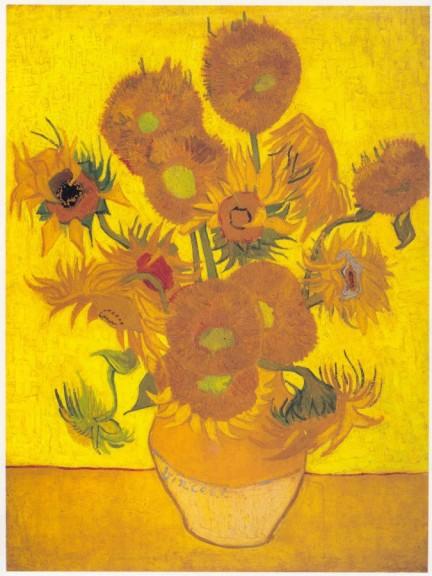
A sense of finality ironically looms over the postmodern suburban dwelling – the chaotic mélange of difference, paradox, ambiguity, irony, indeterminacy, instability and cynicism. In its irregular, episodic, haphazard habitat, the subject confronts the existential angst, the dilemma of choice. Amid this, the idea of breaking free is captivating indeed, as one conjures images of Jonathon Livingston Seagull soar higher, exploring the vast blue expanse – and its own consciousness. Is it possible to assume that the ultimate power lies within one’s own reach that is in consciousness; and the road to freedom waiting to be taken? Tweedlebee’s logic might refer to the mundane; and yet aren’t we free in postulating a ‘logic of the infinite’- invoking, in essence, Kierkegaard’s ‘passion for the possible’ as we imagine ourselves clung to a giant pendulum oscillating between what is given and what is possible, between the present and the absent (perhaps the future)?
Song of the Bird
Where we jostle
Through the harassing crowd
In pursuit of
An El Dorado
Of deep hidden dreams
Latent wishes
Toil
Under the fiery sun
Sweating, suffocating,
Where we lose count of hours spent
Before the machine
One that rumbles
Other programmed
Where the flow of creativity
Seems obstinately,
Even, helplessly plugged.
Amidst cold wintry fog
Shivering, chilling
In mindless frenzy
We play the game
Thrust upon us
And which we invent too.
Where bereft of
That streak of spontaneity
We continue
To meander through the maze.
When …in a subtle
Moment of metamorphosis
In the twilight glow
And clusters of bloom
We hear -
The song of the bird.
It is then we discover
the stark contrast –
The melody of freedom and growth
And the lives of ours – stunted
Utter bonsais.
Where we jostle
Through the harassing crowd
In pursuit of
An El Dorado
Of deep hidden dreams
Latent wishes
Toil
Under the fiery sun
Sweating, suffocating,
Where we lose count of hours spent
Before the machine
One that rumbles
Other programmed
Where the flow of creativity
Seems obstinately,
Even, helplessly plugged.
Amidst cold wintry fog
Shivering, chilling
In mindless frenzy
We play the game
Thrust upon us
And which we invent too.
Where bereft of
That streak of spontaneity
We continue
To meander through the maze.
When …in a subtle
Moment of metamorphosis
In the twilight glow
And clusters of bloom
We hear -
The song of the bird.
It is then we discover
the stark contrast –
The melody of freedom and growth
And the lives of ours – stunted
Utter bonsais.
Monday, June 27, 2005
Problematizing 'Contemporary' Poetry
To begin with, ‘What is Contemporary Poetry?’ As is evident, there seems to be a certain shift in the way poets start writing poems by the end of the two World Wars. This period seems to usher in hope, yet despair, a tone of defiance, non conformity, a ‘poetry of protest’ and escape. In the post colonial situation, the subject’s search for identity, ‘language, subalternity and generally questions of gender, desire, and sexuality acquire greater relevance than ever.
In his Preface to ‘An Anthology of New Indian English Poetry’ Makarand Paranjape writes, “… Modernism is dead … Modernism in Indian English poetry with its notion of a literary avant-garde, its emotional restraint and repression … its belief in the image as the supreme poetic device, its aloofness and alienation from India, its secular dogmatism, its outright rejection of the past, and above all, its arrogant narcissism and self-absorption is thankfully, now passé.” About the “new” poets he claims, “There is no anxiety to conform to any one central idea about their identity or cultural praxis. In this sense, these poets are post modern: they celebrate not conformity but ‘difference’, whether of language, region, nationality, politics, ethnicity, gender or sexual preference.”
In ‘An Introduction’ Kamala Das explores her identity:
‘I am an Indian, very brown, born in
Malabar, I speak three languages, write in Two, dream in one.
Don’t write English, they said,
English is not your mother tongue…’
Again, Nissim Ezekiel’s lines from the ‘Latter-Day Psalms’:
“The images are beautiful birds
and colourful fish: they fly,
they swim in my Jewish consciousness.”
I wonder if there is any singular tone, any uniform voice that can be immediately identified as the ‘contemporary’. Secondly, how long would ‘contemporary’- continue as a slogan? In other words, doesn’t the ‘contemporary’ ever lose relevance and import? What to call what succeeds temporally, or follows the ‘contemporary’? Are we under some sort of a tyranny of the contemporary?
The next concern is the interpretation of contemporary Poetry. How to read a poem? This is apparently a certainly valid question. This is because there is a way (not necessarily one, though) of reading a poem. If that question did not occur at all, we would merely be happy reading poetry to each other, rather than reading papers, criticisms and debates on poetry. Almost immediately this suggests that theorizing or the conscious formulation and articulation of interpretation was somehow more important. But whether that necessarily must be so, is a question that needs equal attention.
The usual theoretical assumption, therefore, is that poetry has purpose and it is to be understood and appreciated in its situation in specific contexts. The role of aesthetic delight, the experience of beauty and rasa in contemporary poetry seems to be fairly unclear.
Going by such argument, more than the lines, it is the subtext that is more important -- what matter are the unsaid, the blanks. When the subtexts are to be reconstructed, there is naturally a way of doing it. Inevitably we become obsessed with interpretation. For instance, when I read the poem -- the post modern way, tentatively I read into it a rejection of grand narratives, defiance against institutionalized power, even State, patriarchal hegemony, etc. The sublime, eternal, perennial concept of beauty and truth is brought under attack. A ‘system of difference’ is sought to be recreated and the inherent relativism owing to cultural and historical dimensions is made explicit.
Here are certain observations. First, the very idea of putting forth a case for a feminist reading of poetry or the Dalitization of poetry, the Black perspective, as such involves a strong sense of politics. More importantly, the defense of the marginalized acutely appeals to the emotional. To question stereotypes, interrogating territorial compulsions, institutions, historical events and processes such as colonialism is really out of an ethical urgency which automatically presupposes the freedom of choice.
However much we wish, an epistemological enquiry into ‘What the poem says’ is infact not a free standing, neutral, a moral question. The answer shall necessarily be a matter of an emotional and ethical preference.
Again, as we do post modernist readings over and over again, is it not just the reversal of the binary opposition? If it is, then there is still a deliberate, a conscious act of privileging. Privileging the marginalized but privileging all the same, and creating inverted power structures in the process. The argument of ‘difference’ has altered our perspectives, but it should not be stretched beyond the point of being counter productive.
Looking at the interpretation of interpretations, Zygmunt Bauman in ‘Hermeneutics and Social Sciences’ points out, “The hermeneutics at a point of time saw ‘understanding’ as residing in a sort of ‘spiritual unification’ of the writer and the reader. It was an interaction…” Thus, when I read a poem, I contribute to its meaning. I think that also needs to be borne in mind.
In the middle of the twentieth century, Roland Barthes resisted the absolute control of the author over ‘meaning’. He famously proclaimed, “The author is dead”. As he himself asserts in his work ‘The Death of the Author’-- “Once the author is removed, the claim to decipher a text becomes quite futile. To give a text an author is to impose a limit on the text, to furnish it with a final signified, to close the writing…”
For Foucault, in contrast, the poem cannot be read in isolation of the person who produced it – the archaeology (i.e. the process of working through the historical archives of various societies to bring to light the discursive formations and events that have produced the fields of knowledge and discursive formations of different historical periods) is extremely important in contextualizing and interpreting the text.
For Derrida still, the text or the poem being situated in a language remains in a state of production. Its meaning is in a state of infinite play. The poem can have multiple meanings. It can, in fact, be doubted as to whether a poet can communicate a fixed thought to the reader through her text (the poem) at all. One can bring R. Sundararajan’s reminder, in ‘Studies in Phenomenology, Hermeneutics and Deconstruction’, ‘Derrida himself has repeatedly drawn attention to the fact that this endless play of the signifiers…may be looked upon as the expression of the productivity of language’. It is not a matter of despondent anxiety. It is rather the articulation of the fecundity of the word and expression of an inherent freedom that drives the creative realm of language and thought.
Let us open the doors, then! I think there is a need to be cautious of the normative call and function of ‘interpretation’ – ‘this-is-how-you-should-read-it’. This is because it has the penchant for slipping into a distorted version, more pedagogical refrain – of ‘this-is-how-you-must-read-it’. Thankfully, for now, this seems to be a remote option.
Therefore, meanwhile, let us keep reading poems anyway:
‘Say it is a paper moon
Sailing over a cardboard sea...’
E.Y. Harburg
Subscribe to:
Posts (Atom)